Tuesday, December 31, 2013
WildAid's Top 5 Stories of 2013
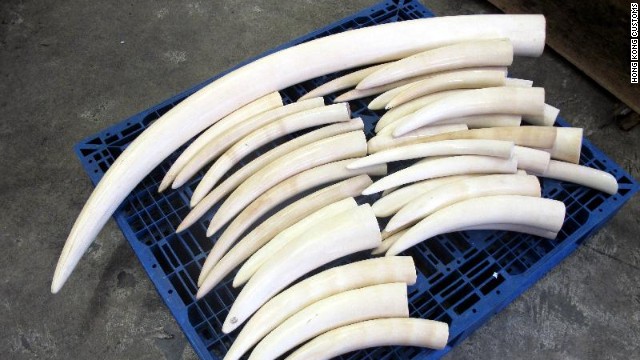
As the poaching crisis gained attention this year, the media reported on the ongoing smuggling efforts of illegal traders. CNN’s Ramy Inocencio reported on “one of the biggest busts of its kind in Hong Kong” when officials seized 1,120 ivory tusks and 13 rhino horns valued at more than $5.3 million.

#4- Big Names Join Demand Reduction Campaigns
This past year saw several big names join the fight to reduce the demand for endangered wildlife products. The Clinton Global Initiative launched a campaign to save African elephants while the Obama administration sought input from NGOs, including WildAid to stop demand for products like ivory and rhino horn. The Duke of Cambridge spoke out in support of demand reduction, even in Mandarin, joining us in our latest message that also features iconic athletes David Beckham and Yao Ming.
#3- Ivory and Terrorism
National security became the focus of several media reports as more evidence linked the trade in illegal wildlife products to groups including Somalia's al-Shabaab and Joseph Kony's Lord's Resistance Army.
#2- Rhinos Killed in Record Numbers
Rhinos were poached at a record pace this year. Nearly 1,000 were killed in South Africa for their horns, up from a then record 668 in 2012 and 13 in 2007. The grim reports came directly from South Africa’s Department of Environmental Affairs and were tempered slightly in December with news that Thandi, a rhino who survived poachers taking her horn, is now pregnant.
#1- Sharks Gain Respect
In 2013 we saw children come together (on a beach) to protect sharks as well as some airlines pledging not to ship fins. Several states in America banned shark fin and even Hong Kong took a stand against shark in soup. However, news that China banned shark fin from state banquets two years ahead of a self imposed deadline sent a message around the globe that will put other governments on notice.
Posted by
spongebrooke
at
9:20 AM
0
comments
Labels: conservation, fish, hoofstock, illegal trade & poaching, legislation, marine life, news, slaughter, wildlife, year in review
Saturday, January 5, 2013
Bee Species Named After 'Big Bang Theory' Catchphrase
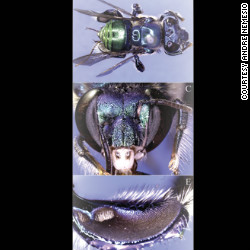
Now, in one of those amusing science-imitates-art moments, "bazinga" has been officially dubbed a species of a bee.
The writers of the hit comedy probably never imagined that the persnickety physicist Cooper's favorite word would be immortalized in actual science.
But thanks to a team of Brazilian biologists, a Brazilian orchid bee is now known by the name Euglossa bazinga.
"The idea was to honor actor Jim Parsons and his brilliant interpretation of Sheldon Cooper," Dr. André Nemésio, a biology professor at the Universidade Federal de Uberlândia in Brazil told CNN.
"The show exaggerates a little bit, but in a sarcastic way, it shows how things do happen in the academic world," he added. "It is fantastic!"
Of course, it doesn't hurt that the name draws attention to these creatures.
"Many orchid-bee species inhabit forested areas that may soon vanish and, as a consequence, it is possible that the bees might disappear, too," Nemésio said.
"For many areas and many species, only a strong action from the society can reverse the extinction process. So, I think it is also a valid way to make people know about these wonderful creatures and the situation concerning their conservation status."
For his part, "Big Bang Theory" executive producer Steve Molaro responded in a press release: “We are always extremely flattered when the science community embraces our show. Sheldon would be honored to know that Euglossa bazinga was inspired by him. In fact, after ‘Mothra’ and griffins, bees are his third-favorite flying creatures.”
Posted by
spongebrooke
at
12:35 PM
0
comments
Labels: invertebrates, news
Monday, September 26, 2011
'Padfoot' For Adoption
Homeless after Harry Potter: Canine movie star Padfoot needs a loving family (and they can even be muggles)
By Mary Mcconnell
Last updated at 3:27 PM on 26th September 2011
While Daniel Radcliffe has gone on to forge an illustrious career on the stage and screen, the fortunes of one of his Harry Potter co-stars have not been quite as lofty.
Black German shepherd Berry, known to millions of children around the world as Padfoot from Harry Potter And The Prisoner of Azkaban, is looking for a new home.
The ten-year-old mutt, who played the animal version of Gary Oldman's character Sirius Black and the godfather to Radcliffe's character Harry, can no longer be looked after by his owner, Paul Thompson.
Trained stuntman Mr Thompson, said he spends too much time away from home to give Berry the attention he deserves.
He told the Sunday Express he is also looking for a new home for Berry's life-long pal Porridge, a German Shepherd cross.
Porridge is also a star of the screen, with roles in The Bill and the TV adaptation of Zadie Smith's novel White Teeth but at the age of 13 the roles have now dried up.
Mr Thompson, said: 'I found myself spending a lot of time away from home. The dogs needed more attention then I could give. It was a difficult decision to make but one I had to accept was best for the dogs.'
The 52-year-old from Elstree, Herts, said he had arranged for the pair, who have been together since they were puppies and cannot be separated, to be fostered by animal re-homing charity German Shepherd Dog Rescue but so far no one has offered them a home.
For more information go to www.germanshepherdrescue.co.uk
Posted by
spongebrooke
at
12:54 PM
0
comments
Labels: celebripets, dogs, movies, news, shelter animals, working animals
Friday, September 16, 2011
6 year old digs up 160 million year old fossil
Emily Baldry stands alongside the 140 million year old fossil (Pic: SWNS)
by Ryan Parry, Daily Mirror 13/09/2011
LITTLE Emily Baldry beams with pride as she poses with a 160million-year-old fossil she dug up using a seaside spade.
The six-year-old unearthed the 130lb, 40cm ammonite after accompanying her father Jon on an archeological trip to Cotswold Water Park, Glos, last year. Now it has been carefully restored by experts and is to go on show at a local visitors’ centre.
The fossil is officially known as a Rieneckia odysseus – but Emily, of Chippenham, Wilts, has affectionately dubbed it Spike.
She says: “I took him to school and all my friends think he’s great.” Dad Jon, 40, said: “It’s an amazing find.”
Link to Story
Posted by
spongebrooke
at
11:42 AM
0
comments
Labels: fossils, invertebrates, marine life, news
Sunday, September 11, 2011
9/11 SAR Dogs Remembered
Posted by
spongebrooke
at
8:13 PM
0
comments
Labels: disaster, dogs, news, working animals
Wednesday, September 7, 2011
Friday, September 2, 2011
Friday Find
Local folks:
1) They are in need of anything and everything as far as supplies and food** go
2) Offer to volunteer and/or foster
3) Adopt 1 or 2 or 3 of course! :)
Non-local folks:
1) The easiest option would be to donate via Chip-In which will be divvied up between the rescues involved.
2) You may donate or ship items directly to the rescues
4) As the Chip-In link says, some will be transported to UT & AZ so keep an eye on your local piggy rescue if you live in one of those states and are looking for a new BFF!
Items needed includes bedding, guinea pig food**, timothy hay**, water bottles, food dishes, etc etc
**Food and hay brands accepted are: Oxbow or KMS Hayloft
Guinea pigs hail from South America where they play an important role in the culture. They are traditionally used in religious ceremonies, folk medicine, and also as a protein source. As pets, they make delightful companions. They are a social animal that prefers having company of their own kind, however can be housed singly as long as a significant amount of time is dedicated to providing attention. Guinea pigs are the most vocal of the rodents and make a variety of noises. They are also quite intelligent and are capable of learning tricks. To learn more about guinea pig care, check out Guinea Lynx.
Posted by
spongebrooke
at
9:39 PM
0
comments
Labels: friday find, news, rescue, rodents, shelter animals
Monday, June 27, 2011
Rescue Dogs Turn Vick House of Horrors into House of Hope
Rescue dogs arrive at old Vick home: wavy.com
Rescue Dogs Arrive At Old Vick Home
Home to become dog rescue facility
Updated: Monday, 27 Jun 2011, 10:07 AM EDT
Published : Monday, 27 Jun 2011, 6:07 AM EDT
SURRY COUNTY, Va. (WAVY) - The first of many rescue dogs arrived Sunday to the home once owned by Michael Vick in Surry County.
It was once the home of dogfighting rings, but now the home is officially becoming a dog rescue facility.
A rescue group called Dogs Deserve Better bought the 15 acre property in May.
The group plans to renovate the property and make it a state of the art facility for hundreds of dogs who were either chained or penned.
"We want this place to be a memorial to all the dogs who lost their lives here," said Tamira Thyne with Dogs Deserve Better. "I don't want our dogs here, because I do think there's been a lot of sadness and a lot of pain here."
The group is in need of volunteers and funding.
If you would like to donate time or money, visit www.dogsdeservebetter.org .
Posted by
spongebrooke
at
5:28 PM
0
comments
Labels: animal cruelty, dogs, facilities, news, rescue, shelter animals, video
Thursday, May 27, 2010
Tuesday, May 11, 2010
Aid Needed for Wildlife in BP Oil Spill
21 years after Exxon and the effects are still being felt. Currently in the Gulf Coast it is nesting season for several endangered species including sea turtles and pelicans. The NWF are on the forefront and list several ways you can help this delicate ecosystem survive this tragedy.
How You Can Help Wildlife Impacted by the BP Oil Spill
Posted by
spongebrooke
at
7:23 PM
0
comments
Labels: biodiversity, disaster, marine life, news, wildlife
Monday, April 7, 2008
Alligator Blood May Lead to Powerful New Antibiotics
Amitabh Avasthi for National Geographic News
April 7, 2008
Alligators often engage in violent fights over territories and mates, and scientists have puzzled over why their wounds rarely get infected.
Now researchers think the secret lies in the reptiles' blood.
Chemists in Louisiana found that blood from the American alligator can successfully destroy 23 strains of bacteria, including strains known to be resistant to antibiotics.
In addition, the blood was able to deplete and destroy a significant amount of HIV, the virus that causes AIDS.
Study co-author Lancia Darville at Louisiana State University in Baton Rouge believes that peptides—fragments of proteins—within alligator blood help the animals stave off fatal infections.
Such peptides are also found in the skin of frogs and toads, as well as in Komodo dragons and crocodiles. The scientists think that these peptides could one day lead to medicines that would provide humans with the same antibiotic protection.
"We are in the process of separating and identifying the specific peptides in alligator blood," said Darville, who presented the findings on Sunday at the 235th national meeting of the American Chemical Society in New Orleans.
"Once we sequence these peptides, we can obtain their chemical structure to potentially [create new] drugs."
Alligator Cream
Study co-author Mark Merchant, a biochemist at McNeese State University in Lake Charles, Louisiana, was among the first to notice alligators' unusual resistance.
He was intrigued that, despite living in swampy environments where bacteria thrive, alligators that suffered frequent scratches and bruises rarely developed fatal infections.
Merchant therefore created human and alligator serum—protein-rich blood plasma that has had clotting agents removed—and exposed each of them to 23 strains of bacteria.
Human serum destroyed only eight of the bacterial strains. But the alligator serum killed all 23, including drug-resistant bacteria such as MRSA (methicillin-resistant Staphylococcus aureus).
When the alligator serum was exposed to HIV the researchers found that a good amount of the virus was destroyed.
The study team thinks that pills and creams containing alligator peptides could be available at local pharmacies within seven to ten years.
Such products would be a boon to patients that need extra help preventing infections, such as diabetes patients with foot ulcers, burn victims, and people suffering from auto-immune diseases.
But there may be potential hurdles before alligator-based medicines can reach drugstore shelves.
For example, Darville noted, initial tests have revealed that higher concentrations of the alligator serum tend to be toxic to human cells.
Not So Primitive
Adam Britton is a biologist based in northern Australia who has found similar antimicrobial proteins called crocodillins in the blood of crocodiles.
Antimicrobial peptides in crocodiles and alligators are part of the animals' innate immune systems, Britton said, which provide automatic protection from certain diseases.
By contrast, human immunities are adaptive—people develop resistance to many diseases after exposure, such as the low doses given in vaccines.
Although innate immunity is often considered primitive, there is nothing primitive about its effectiveness, Britton said.
Innate immunities "usually serve to amplify the adaptive immune system, often by weakening the membranes of bacteria," he said.
"It appears that alligator and crocodile antimicrobial peptides are extremely effective agents" against bacteria, he added.
Britton hopes to use Australian crocodile blood to complement the latest work on alligators and answer questions about what these proteins mean for immune systems in general.
"If we can harness these secrets," Britton said, "we could be on the verge of a major advance in medical science."
Saturday, March 29, 2008
Giant, Unknown Animals Found off Antarctica
March 28, 2008—Giant sea stars or starfish that measure 24 inches (60 centimeters) across are held by Sadie Mills, left, and Niki Davey of New Zealand's National Institute of Water and Atmospheric Research on February 15, 2008.
They and other researchers collected 30,000 sea creatures—many new to science—during a 35-day census in Antarctic waters in February and March, according to a March 26 announcement.
The large-scale survey was part of the International Polar Year and Census of Antarctic Marine Life programs, which study the diversity of Antarctic marine life.
This hydroid—likely a new species—measures 2.5 inches (6.5 centimeters) across its “head” and has stalks over 39 inches (100 centimeters) long.
The colorful coral-like animal was snagged from one of 39 sites surveyed by New Zealand scientists in southern Antarctica's Ross Sea in February and March 2008.
On the 2,000-mile (3,218-kilometer) journey, the team collected specimens from the surface to the seabed, where this hydroid was found.
Collected from the Ross Sea shelf in southern Antarctica, this 9.8-inch-long (25-centimeter-long) giant sea spider was one of 30,000 animals found during a 35-day census in early 2008.
The marine arachnids, which prey on hydroids and bryzoans—branching, coral-like animals—are larger and more common in Antarctic waters than anywhere else on Earth.
Cold temperatures, few predators, and high levels of oxygen in seawater could explain their gargantuan size, Don Robertson of New Zealand's National Institute of Water and Atmospheric Research told the Associated Press.
A mysterious animal with a small crustacean perched on its back floats 7,218 feet (2,200 meters) below the surface in the Ross Sea off southern Antarctica.
The 19-inch-long (50-centimeter-long) creature might be a tunicate, or sea squirt, say scientists who found it during a large-scale survey of Antarctic life in early 2008.
The Antarctic summer's perpetual daylight meant that the New Zealand team could canvass the sea day and night.
An Antarctic octopus found at 3,280 feet (1,000 meters) in southern Antarctica's Ross Sea was one of about 18 octopus species recorded during a survey conducted in early 2008.
New Zealand scientists estimate they also collected 88 species of fish—8 of which are new species—as well as 8 species of squid on the 50-day journey.
This predatory fish, called a stareater, uses its luminous red chin appendage to lure prey into striking distance.
The fish was one of more than 30,000 marine creatures hauled up by a team of 26 scientists and 18 crew during a census of Antarctic life in early 2008.
The team endured icy weather as cold as 8.6 degrees Fahrenheit (minus 13 degrees Celsius)—which caused equipment to freeze up and samples to ice over as soon as they landed on deck.
This 19-inch-long (50-centimeter-long) daggertooth sports a striking iridescent body and sapphire blue eyes.
An Antarctic neighbor of the predatory stareater, this fish is one of the southernmost daggertooths ever caught, said New Zealand scientists who captured it during a marine census in early 2008.
The animal uses its long mouth and forward-curved teeth immobilize prey, clamping down and pulling back to tear through and paralyze the victim's spine.
This sea cucumber—held by Sadie Mills of New Zealand's National Institute of Water and Atmospheric Research—is known as a sea pig.
Mills and colleagues collected the organism, among more than 30,000 animals, during a marine census of southern Antarctica in early 2008.
Sea cucumbers are part of a group of marine animals that inhabit the seafloor, including sea squirts, sea stars (starfish), sea slugs, corals, clams, sponges, and urchins.
This shrimplike crustacean was collected 985 feet (300 meters) deep on the Ross Sea shelf, during a marine census led by New Zealand scientists in early 2008.
This amphipod species was first discovered during a 2004 Antarctic voyage aboard the research ship Tangaroa.
The tiny creatures are found in both seawater and fresh water, as well as in mud and sand.
High-powered cameras photographed this sea star or a starfish of the genus Labediaster (lower left) surrounded by brittle stars on a seamount 492 feet (150 meters) below the surface of Antarctica's Ross Sea.
The early-2008 marine survey is expected to yield eight new mollusk species, Stefano Schiaparelli of Italy's National Antarctic Museum in Genoa told the Associated Press.
“This is a new brick in the wall of Antarctic knowledge,” he said.
--National Geographic
Posted by
spongebrooke
at
9:18 PM
0
comments
Labels: fish, invertebrates, marine life, news, research, wildlife
Friday, March 7, 2008
White Killer Whale Spotted Off Alaska
Researchers working near Alaska's Aleutian Islands on Feb. 23 spotted a white killer whale, which they estimate was 25 to 30 feet long and weighed more than 10,000 pounds. This is only the third time in the past 15 years that such a whale has been seen in the area.
White Killer Whale Spotted Off Alaska
By MARY PEMBERTON,AP
Posted: 2008-03-07 10:57:34
Filed Under: Science News
ANCHORAGE, Alaska (March 7) - The white killer whale spotted in Alaska's Aleutian Islands sent researchers and the ship's crew scrambling for their cameras.
The nearly mythic creature was real after all.
"I had heard about this whale, but we had never been able to find it," said Holly Fearnbach, a research biologist with the National Marine Mammal Laboratory in Seattle who photographed the rarity. "It was quite neat to find it."
The whale was spotted last month while scientists aboard the Oscar Dyson, a National Oceanic and Atmospheric Administration research ship, were conducting an acoustic survey of pollock near Steller sea lion haulout sites.
It had been spotted once in the Aleutians years ago but had eluded researchers since, even though they had seen many of the more classic black and white whales over the years.
Fearnbach said the white whale stood out.
"When you first looked at it, it was very white," she said Thursday.
Further observation showed that while the whale's saddle area was white, other parts of its body had a subtle yellowish or brownish color.
It likely is not a true albino given the coloration, said John Durban, a research biologist at NOAA's Alaska Fisheries Science Center in Seattle. That's probably a good thing - true albinos usually don't live long and can have health problems.
Durban said white killer whales have been spotted elsewhere in the area twice before: in 1993 in the northern Bering Sea around St. Lawrence Island and in 2001 near Adak in the central Aleutians. There have also been sightings along the Russian coast.
While Alaska researchers have documented thousands of black and white killer whales in the Bering Sea and the Aleutians during summer surveys, this was something new and exciting, Durban said.
"This is the first time we came across a white killer whale," he said.
The scientists observed several pods over a two-week period. The white whale was in a family group of 12 on a day when the seas were fairly rough. It was spotted about 2 miles off Kanaga Volcano on Feb. 23.
The ship stayed with the whale for about 30 minutes.
"Everybody actually came out and was taking pictures," Fearnbach said. "It was a neat sighting for everybody."
The whale appeared to be a healthy, adult male about 25 to 30 feet long and weighing upward of 10,000 pounds.
~~~~~~~~~~~~~~~~~~~~~~~~~~~~~~~~~~~~~~~~~~
Chimo was another white orca that was captured in the 1970's.
Posted by
spongebrooke
at
7:58 PM
0
comments
Labels: marine life, news, wildlife
Sunday, March 2, 2008
Rare Animals Flee Fires in Kenya Park
February 25, 2008—Rhinoceroses flee fires in Kenya's Lake Nakuru National Park on February 23, 2008.
After beginning on February 21, the blazes have so far destroyed about a third of the park's 72 square miles (188 square kilometers), which are home to leopards, flamingos, giraffes, zebras, both black and white rhinos, and hundreds of other species.
"The buffalo really panicked, going in this direction and that," observer Jayne Nguatah told the Times of London. "There were rhino and impala as well, all trying to get out of the way."
Nakuru's black rhinos may have borne the brunt of the disaster. Listed as critically endangered by the World Conservation Union, the species numbers only about 60 in the park, and its chief foraging areas—the park's forests—were among the hardest hit areas of the park.
No human fatalities have been reported as a result of the fires.
Link to rest of story
Friday, January 25, 2008
Vick dogs make their debut
The gag order is lifted as the last defendant is sentenced and Bad Rap opens up about their experiences and discoveries made when evaluating the ex-fighting dogs.
See video, pictures, a timeline, and the entire process on Bad Rap's website here- A Second Chance for the Vick-tims
Their blogspot has also been updated and can be read here
These dogs were immediately labeled "ticking timebombs" by PETA and HSUS who took it upon themselves to decide it was best that they be put down with no further evaluation because of their fighting background. But evaluation of these dogs may help reinvent how to assess prior fighting dogs and show that shelters need to treat them on an individual basis instead of generalizing. You may recall that only ONE dog failed the rigerous temperament test admistered by both Bad Rap and the ASPCA.
Thanks to good people like Bad Rap and ASPCA EVERY dog no matter what breed, size, or background has an equal chance at finding that perfect home.
Posted by
spongebrooke
at
1:07 PM
0
comments
Labels: animal cruelty, dogs, news, rescue, shelter animals
Tuesday, January 15, 2008
Would you eat cloned meat?
Cloned Animals Safe to Eat, Says FDA
Lauran Neergaard, Associated Press
Jan. 15, 2008 -- Meat and milk from cloned animals is as safe as that from their counterparts bred the old-fashioned way, the Food and Drug Administration said Tuesday.
The decision removes the last U.S. regulatory hurdle to marketing products from cloned cows, pigs and goats, and puts the FDA in concert with recent safety assessments from European food regulators and several other nations.
"The data show that healthy adult clones are virtually indistinguishable" from their counterparts, concludes FDA's 900-plus page safety report.
But for economic reasons, it will be years before many foods from cloned animals reach store shelves. At $10,000 to $20,000 per animal, they're a lot more expensive than ordinary cows. That means producers likely will us clones' offspring for meat, not the clones themselves.
In addition, several large food companies -- including dairy giant Dean Foods Co. and Hormel Foods Corp. -- have said they have no plans to sell milk or meat from cloned animals, because of consumer anxiety about the technology.
With FDA's ruling, "If you ask what's for dinner, it means just about anything you can cook up in a laboratory," said Carol Tucker-Foreman of the Consumer Federation of America, who pledged to push for more food producers to shun cloned animals.
The two main U.S. cloning companies, Viagen Inc. and Trans Ova Genetics, already have produced more than 600 cloned animals for U.S. breeders, including copies of prize-winning cows and rodeo bulls.
"We certainly are pleased," said Trans Ova President David Faber, who noted that previous reports by the National Academy of Sciences and others have reached the same conclusion.
"Our farmer and rancher clients are pleased because it provided them with another reproductive tool," he added.
Food producers have voluntarily withheld cloned animals from the market pending FDA's decision, and it wasn't immediately clear Tuesday if that moratorium was ending immediately -- or if other government agencies must weigh in first.
The ruling was long-expected -- and mirrors FDA's initial safety assessment back in 2003 -- but highly controversial nonetheless. Debate has been fierce within the Bush administration as to whether the FDA should move forward, largely because of trade concerns. Consumer advocates petitioned against the move, and Congress had passed legislation urging the FDA to study the economic ramifications before moving ahead.
It was a day forecast since 1997, when Scottish scientists announced they had successfully cloned Dolly the sheep. Ironically, sheep aren't on the list of FDA's approved cloned animals; the agency said there wasn't as much data about their safety as about cows, pigs and goats.
By its very definition, a successfully cloned animal should be no different from the original animal whose DNA was used to create it.
But the technology hasn't been perfected -- and many attempts at livestock cloning still end in fatal birth defects or with deformed fetuses dying in the womb. Moreover, Dolly was euthanized in 2003, well short of her normal lifespan, because of a lung disease that raised questions about how cloned animals will age.
The FDA's report acknowledges that, "Currently, it is not possible to draw any conclusions regarding the longevity of livestock clones or possible long-term health consequences" for the animal.
But the agency concluded that cloned animals that are born healthy are no different from their non-cloned counterparts, and go on to reproduce normally as well.
"The FDA says, 'We assume all the unhealthy animals will be taken out of the food supply,'" said Joseph Mendelson of the Center for Food Safety, a consumer advocacy group that opposes FDA's ruling. "They're only looking at the small slice of cloned animals that appear to be healthy. ... It needs a lot further study."
Posted by
spongebrooke
at
11:18 PM
0
comments
Saturday, January 12, 2008
Cloned Pigs Glow
Cloned Pigs Glow Like Their Mom
Christopher Bodeen, Associated Press
They Have Their Mom's Hue Jan. 9, 2008 -- A cloned pig whose genes were altered to make it glow fluorescent green has passed on the trait to its young, a development that could lead to the future breeding of pigs for human transplant organs, a Chinese university reported.
Two of the 11 piglets glow fluorescent green from their snout, trotters, and tongue under ultraviolet light, according to Northeast Agricultural University, located in the city of Harbin.
Their mother was one of three pigs born with the trait in December 2006 after pig embryos were injected with fluorescent green protein.
"Continued development of this technology can be applied to ... the production of special pigs for the production of human organs for transplant," Liu Zhonghua, a professor overseeing the breeding program, said in a news release posted Tuesday on the university's Web site.
The birth of the glowing piglets proves such transgenic pigs are fertile and able to pass on their engineered traits to their offspring, Liu said.
"The smooth birth of these transgenic fluorescent green pigs testifies to the mature development of our country's use of somatic cell nuclear transfer technology to produce transgenic pigs," Liu said.
Calls to the university seeking comment Wednesday were not answered.
Robin Lovell-Badge, a genetics expert at Britain's National Institute for Medical Research, said the technology "to genetically manipulate pigs in this way would be very valuable."
Lovell-Badge had not seen the research from China's cloned pigs and could not comment on its credibility. He said, however, that organs from genetically altered pigs would potentially solve some of the problems of rejected organs in transplant operations.
He said the presence of the green protein would allow genetically modified cells to be tracked if they were transplanted into a human. The fact that the pig's offspring also appeared to have the green genes would indicate that the genetic modification had successfully penetrated every cell, Lovell-Badge added.
But he said much more research and further trials -- both in animals and in humans -- would be necessary before we could see the benefits of the technology.
Other genetically modified pigs have been created before, including by Scotland's Roslin Institute, but few results have been published.
Tokyo's Meiji University last year successfully cloned a transgenic pig that carries the genes for human diabetes, while South Korean scientists cloned cats that glow red when exposed to ultraviolet rays -- an achievement they said could help develop cures for human genetic diseases.
Posted by
spongebrooke
at
12:04 AM
0
comments
Thursday, December 27, 2007
Terri Irwin- Japan's scientific whale kill is a sham
Terri Irwin to Launch Whale Rescue
Associated Press
On a Mission Dec. 27, 2007 -- The widow of TV "Crocodile Hunter" Steve Irwin announced Thursday she will launch non-lethal research of whales in Antarctic waters next year in hopes of showing that Japan's scientific whale kill is a sham.
Tokyo has staunchly defended its annual cull of more than 1,000 whales as crucial for research, saying it is necessary to kill the whales to properly gather information about their eating, breeding and migratory habits.
Environmentalists and anti-whaling nations say the slaughter is commercial whaling in disguise, because much of the meat from the whales ends up being sold commercially.
Terri Irwin said that a whale watching program she started to honor her late husband would expand into scientific research in 2008. Steve Irwin, the high-profile wildlife show host and environmental campaigner, was killed by a stingray last year off Australia's Great Barrier Reef.
"We are working with Oregon State University to do formalized research in the southern hemisphere," Terri Irwin told the Nine Network television. "We can actually learn everything the Japanese are learning with lethal research by using non-lethal research."
Japan's whaling fleet is run by a government-backed research institute and operates under a clause in International Whaling Commission rules that allows whales to be killed for scientific purposes.
Japan had planned to kill up to 50 endangered humpback whales this season, but backed away from the plan in the face of strong international condemnation.
"We are determined to show the Japanese they can stop all whaling, not just humpbacks," Irwin said.
Further details of Irwin's planned research program were not immediately available.
Earlier this month, Irwin threw her support behind a radical conservation group that has vowed to disrupt Japan's annual whale hunt, allowing the U.S.-based Sea Shepherd Conservation Society to rename one of its flagship vessels after her late husband.
Sea Shepherd has come under heavy criticism in recent years for engaging in violent tussles with the Japanese whaling fleet in Antarctic waters.
Posted by
spongebrooke
at
10:19 PM
0
comments
Labels: conservation, marine life, naturalist, news, slaughter, wildlife
Wednesday, November 28, 2007
Scientists find Nemo's Cousin
Finding Nemo's Cousin: Scientists Spot New Marine Species
Oct. 16, 2007 — A swimming sea cucumber, a Nemo-like orange fish and a worm with tentacles sprouting from its head are among dozens of possible new species found during a survey of the Celebes Sea, researchers said Tuesday.
A team of U.S. and Filipino scientists plunged up to three miles underwater in early October in an area that has been isolated by rising sea levels and may have spawned sea life not found elsewhere.
They collected between 50 and 100 potentially undiscovered species of marine invertebrates and fishes.
"These waters are the richest biological regions of the world but have been largely unexplored," said expedition leader, Larry Madin, of the Woods Hole Oceanographic Institute.
The survey was conducted by Woods Hole, National Geographic and Filipino scientists at the Coral Triangle — bodies of water bounded by the Philippines, Indonesia and Malaysia that are known to contain the world's richest biodiversity in shallow water marine species.
It will take a few more weeks of study of the deepwater sea life samples before they can be declared new species, Madin said during a video presentation of the findings in Manila.
Among the more unusual finds were an orange-tinged sea cucumber that uproots itself from the seabed and swims using flaps on its transparent body, and a worm with tentacles coming out of its head and transparent paddle fins growing all over its tan body.
"We don't know what this is," Madin said of the worm. "It might be something big."
Of the fish collected, a tiny, angular orange one with a puckered yellow mouth looked like the main character in the animated Hollywood film "Finding Nemo," Madin said.
The team also collected various types of deepwater jellyfish, predatory eels and single-celled organisms — as well as piles of household garbage.
The area holds promise for more discoveries, Madin said.
Posted by
spongebrooke
at
3:58 PM
0
comments
Labels: marine life, news
Sunday, November 11, 2007
This Fragile Earth
To commemorate TIME's Heroes of the Environment, a whirlwind tour of some of the wildlife and ecosystems most endangered by global warming.
Posted by
spongebrooke
at
1:15 PM
0
comments
Labels: climate change, news, wildlife